



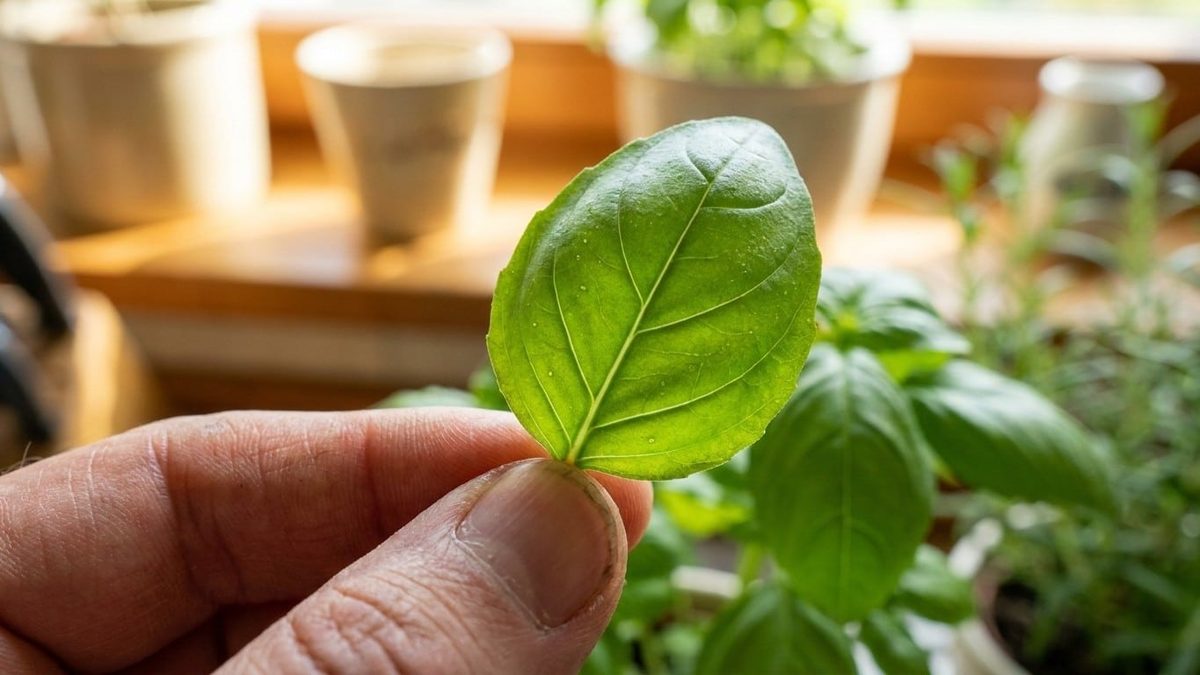

Those tiny white spikes rising from the center of your basil plant look like triumph. They signal health. They signal a happy, thriving green life.
Wrong.
That bloom isn’t a celebration. It’s a surrender. When basil flowers, it isn’t evolving. It’s dying. The plant has made the executive decision to end its cycle, and it is withdrawing all resources to do so. If you see those white tips, you are looking at the terminal phase of an annual herb.
The good news? You can reverse it. A simple, free pinch can triple your leaf production and save the harvest.
Зміст
The Biology of the Bloom
Common basil (Ocimum basilicum ) is an annual. Its entire existence is a sprint through the warm months. Grow. Flower. Seed. Decline.
Once that biological script starts playing, the plant enters “mission accomplished” mode. Flowering and seeding mark the end of its life. It has reproduced. Its job is done. It begins to wither.
When this shift happens, the plant’s energy redirects. It stops building leaves. Instead, it funnels nutrients into seed production. The leaves that remain don’t just get smaller. They thicken. They turn bitter. They lose their punch.
This isn’t metaphorical. It’s a complete biological rerouting. The flavor you’re tasting isn’t just “off.” It’s abandoned. The plant has cut off the supply of essential oils that give basil its aroma.
Environmental stress accelerates this. Heat is the main culprit. Temperatures above 30°C force the plant into early flowering. Drought does it too. A dry soil stresses the roots. The plant panics. It thinks, “I’m dying. I need to make seeds now.” A hot summer. A forgotten watering during a long weekend. The whole timeline collapses.
The Pinch: The Habit That Changes Everything
The solution isn’t a product. It’s your thumb.
Start pinching basil when the plant hits about 15 centimeters. This forces branching. It stops the upward climb toward flowers. The plant, denied its primary goal, redirects energy back into leaf production.
It takes three seconds. Do it twice a month.
Use your fingernails, not scissors. Metal tools can crush the plant tissue, creating entry points for disease. Pinch just above a node or leaf pair. This刺激 (stimulates) lateral growth.
The result is immediate. Instead of one tall, spindly stem, you get a bushy, compact plant. It spreads. It thickens.
Over a single season, regularly pinched basil yields up to three times more leaves than an unpruned plant. Think of it as the difference between two Caprese salads and six. Same pot. Same window. Same plant.
Aim for a pinch every two to three weeks. This keeps the plant in a vegetative growth loop.
Here is the counterintuitive part: don’t wait until you need basil. Harvesting triggers growth. By pinching the tips regularly, even if you only need a few leaves, you send a constant signal: Grow more. Don’t flower. More cuts equal more productivity. Less chance of blooming.
Saved from the Edge
Your basil has already flowered. Is it gone?
Not necessarily. But time is short.
Early-stage flowers mean the leaves are still aromatic. Long, tall flower spikes mean the leaves are hard and flavorless. You need to act now.
- Identify the spike.
- Cut the entire floral stem down to the first pair of healthy leaves below it.
- Pinch hard. This stops the reproductive process and attempts to redirect energy back to leaves.
If you catch it at the bud stage, you can save the harvest. Give the plant a second life.
If the flowers are fully open, the leaf quality has likely dropped. After removing the blooms, cut back the plant by one-third. This hard pruning helps rejuvenate the remaining foliage.
Don’t Throw Away the Flowers
You can still use the blooms.
They are edible. In fact, they are potent. The flavor is stronger than the leaves, often with a peppery kick. Some chefs grind them into pesto for an extra kick. Others infuse them in water or vinegar for a subtle aromatic twist.
They aren’t waste. They are just a different note in the same song.
But let’s be honest. You want the leaves. The bright, sweet, oily leaves that taste like summer.
So pinch. Pinch before you need it. Pinch when you think it looks fine. Pinch until it looks like a lush, green monster that refuses to die.
The white flowers will come if you let them. But why let them?
The best basil isn’t the one that survives. It’s the one you keep forcing to live.
Pinching a stem isn’t just a haircut for the plant. It’s an invitation to multiply.
Place that cut end in a glass of water. Wait. In seven to fourteen days, you’ll see roots emerging. White, fragile, alive.
Next, move it to a light, airy soil. The new plant will be a genetic clone of the parent. This is the simplest way to get free basil. One plant bought in spring becomes six by July. No cost. Just patience and a jar.
Stop the Flower, Save the Flavor
Regular pinching does more than shape the bush. It delays flowering.
Why does this matter? Flowers signal the end of the leafy phase. The plant shifts energy from leaf production to seed creation. The leaves turn bitter. The aroma fades.
Cut the white flowers before they take over. They look fine, but they compromise the taste.
By removing the buds early, you keep the plant in vegetative mode. More leaves. Stronger scent. A continuous harvest.
This requires a shift in mindset. Don’t treat basil as balcony decoration. Treat it as a mini-vegetable garden. Manage it. Prune it. Check it.
The white blooms are pretty. But they mark the end of the fun. Cut them off. Keep the flavor. Keep the supply.