





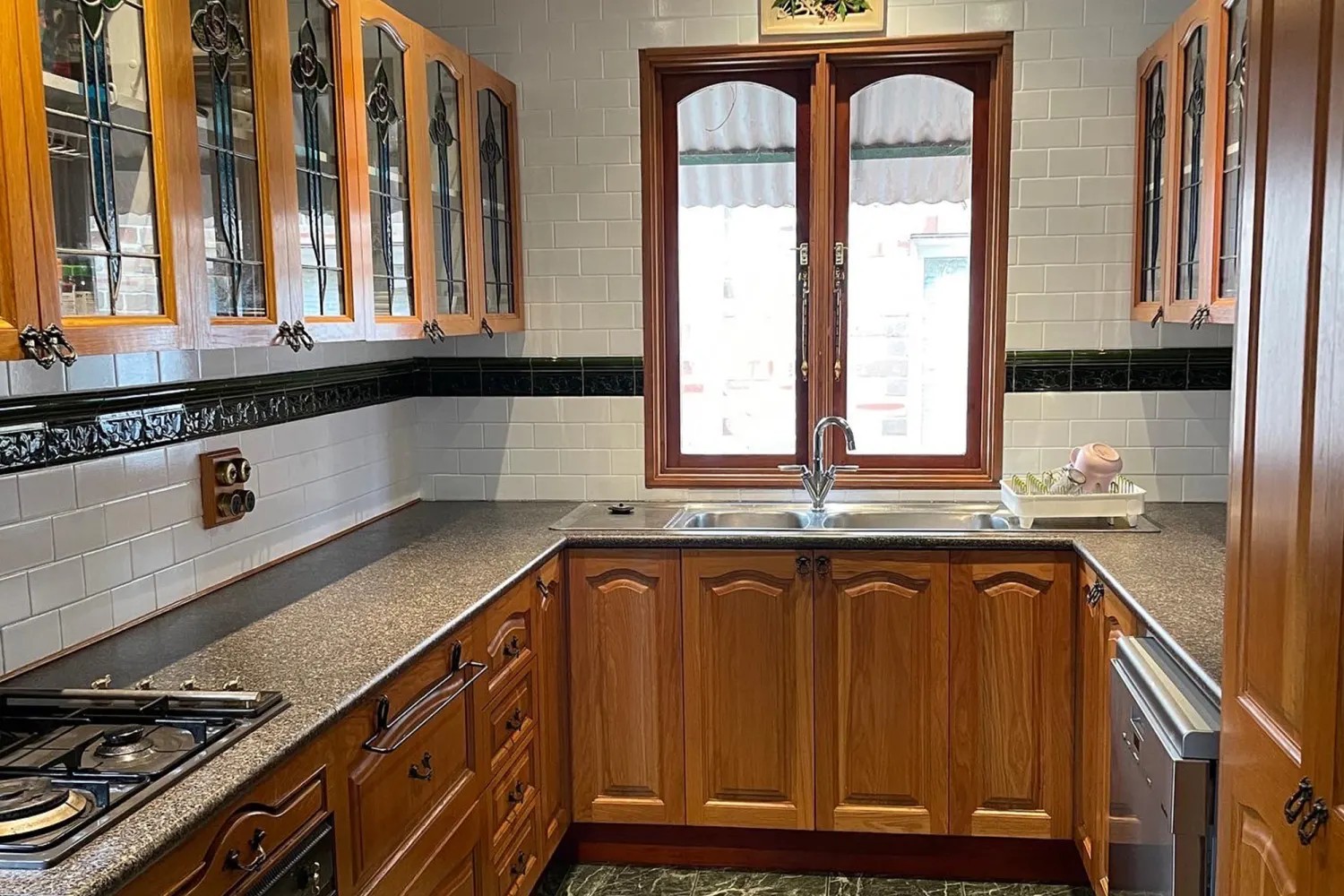
When Heath and Samantha Mitchell moved into their cottage-style home in Sydney, Australia, they were immediately drawn to its historic charm. However, the kitchen stood in stark contrast to the rest of the house. What should have been a cozy, rustic space felt trapped in a bygone era, defined by a palette of “lifeless” colors and dated textures.
Through a series of strategic, budget-friendly DIY updates, the couple managed to transform the room from a dark, 1980s relic into a vibrant, character-filled oasis—all without hiring a professional contractor.
The “Quick Fix” That Spiraled
The renovation began with a common homeowner’s misconception: the idea that a simple paint job on the cabinetry would be enough to refresh the room.
As the Mitchells quickly discovered, design elements are interconnected. The original “golden” timber-look cabinets were paired with yellowing cream tiles and a dark gray speckled benchtop. Any attempt to change the cabinet color would have been undermined by the surrounding dated surfaces. What was intended to be a minor cosmetic tweak evolved into a comprehensive overhaul of the kitchen’s visual identity.
A Layered Approach to Transformation
To achieve a cohesive look, the couple tackled the space in stages, focusing on light, color, and texture:
1. Brightening the Framework
The first priority was to lift the heavy, dark atmosphere of the room. By painting the ceiling, window frames, and cornices a crisp white, they created a sense of airiness. This was particularly important for the window frames, which helped draw attention to the kitchen’s most prized feature: the original historic stained glass windows.
2. The Tile and Cabinet Overhaul
Rather than undergoing the costly and messy process of ripping out old tiles, the Mitchells turned to DIY tutorials to paint them. Using specialized Dulux paint, they were able to mask the aged cream color and create a fresh backdrop.
The cabinetry underwent an even more rigorous process. To ensure a professional finish, the couple:
– Removed the cabinet doors entirely.
– Sanded the surfaces down.
– Applied multiple coats of primer.
– Settled on a sophisticated shade of green (“Webster Park” by British Paint ) after weeks of testing various navy and green combinations.
3. Hardware and Surfaces
Small details often yield the highest return on investment. The couple replaced the “gothic-like” black handles with modern brass fixtures. This choice provided a warm, contemporary contrast to the new teal-green cabinetry.
For the countertops, the Mitchells sought a middle ground between the old gray speckled surface and a stark, plain white. They opted for a marble-inspired contact paper, providing a high-end look and texture without the expense of full stone installation.
Lessons from the DIY Journey
The transformation was not without its setbacks. The couple faced several “roadblocks,” including the accidental breaking of two historic stained glass panels—a moment Samantha described as “heart-shattering.” They also learned that certain decisions, like the countertops, may only be temporary fixes until a full replacement is possible.
Despite these challenges, the project serves as a masterclass in how to respect historic architecture while modernizing its utility. By focusing on color theory and surface updates, they successfully shifted the kitchen from a dated obstacle to a dramatic focal point that honors the home’s heritage.
Conclusion: By prioritizing light, strategic color choices, and updated hardware, the Mitchells proved that a dramatic kitchen transformation is possible through dedicated DIY effort, even when working within the constraints of an older home.