




Fifty billion. That is the number of bacteria hiding in a single cubic centimeter of your kitchen sponge. Do the math on a standard 300 cm³ sponge. The number is dizzying. For years, millions of households have tried to fix this by soaking their sponge in bleach every night. It feels thorough. It smells clean. But it doesn’t work.
The reality is that your kitchen sponge is a biological hazard zone. You need to stop relying on bleach for disinfection. The science is clear: bleach leaves a significant portion of bacteria alive, while simpler methods like microwaving destroy nearly everything in minutes.
Зміст
The Myth of the “Cleanest” Spot in the House
We assume the toilet is the dirtiest place in the house. That is wrong. Kitchens harbor more microbes than bathrooms. The primary culprit? The kitchen sponge.
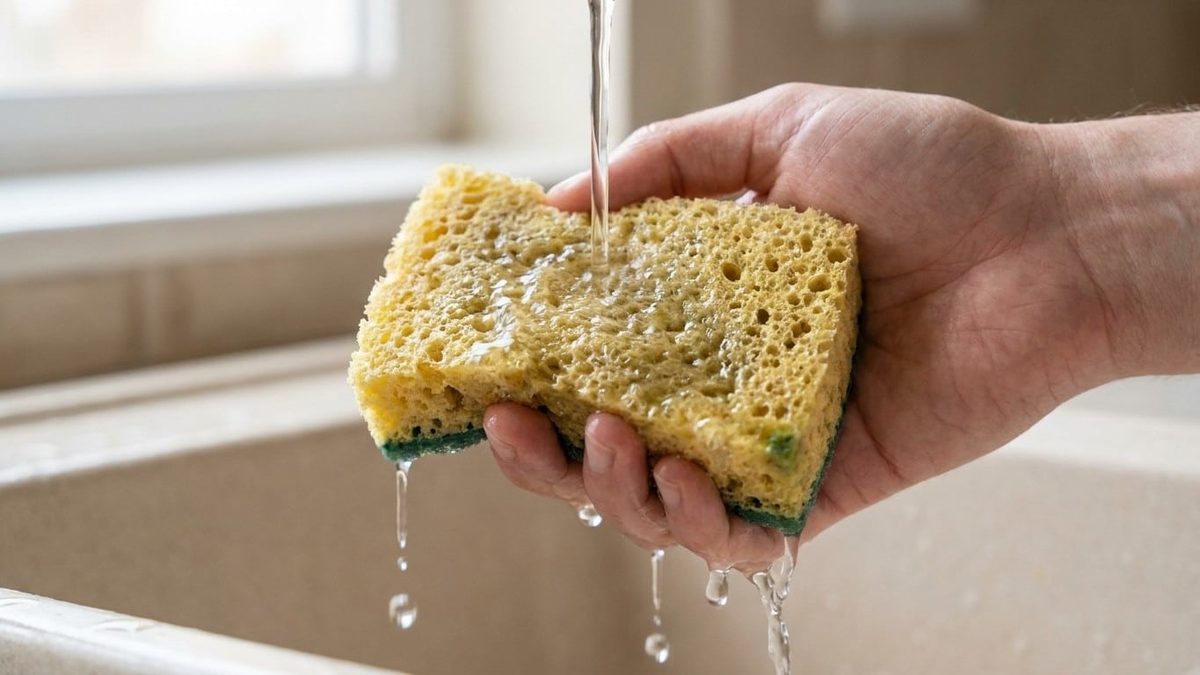
It represents the largest reservoir of living bacteria in the home. The reason is structural. Many bacteria thrive in environments with multiple tiny tunnels where they can hide and multiply. A kitchen sponge offers both a smooth surface for wiping and a porous interior full of holes. This makes it a five-star hotel for microbes.
Consider the timeline of contamination. In just ten hours, a single unelected salmonella can multiply into a billion units. That is the gap between your dinner and your breakfast. Ten hours is all it takes to turn a harmless crumb into a source of gastroenteritis, food poisoning, or skin infections.
When you wipe your counter with that sponge, you aren’t cleaning. You are redistributing billions of bacteria across your surfaces, including where you prepare food. Researchers call this “cross-contamination.” The sponge acts as a diffuser. It spreads the problem rather than solving it.
Why Bleach Gives You a False Sense of Security
Soaking your sponge in bleach is a reflex. It is reassuring. It is scientifically insufficient.
Studies show that while bleach kills between 37% and 87% of bacteria, that leaves enough survivors to make you sick. In the best-case scenario, you still have one in ten bacteria surviving. In the worst case, two-thirds remain.
The failure lies in the sponge’s porous architecture. That same structure that makes it great for soaking up spills also protects germs from water jets and detergents. Bleach penetrates only the surface. It cannot reach the deep cavities where bacterial colonies have taken refuge.
The French Agency for Food, Environmental and Occupational Health & Safety (Anses) notes that bleach is effective only if you first wash the sponge thoroughly and then let it sit for five minutes in a precise solution. You must never mix bleach with acidic products or heat it. Even under these perfect conditions, the result is far inferior to another method that is simpler and more reliable.
The Microwave: Two Minutes That Change Everything
According to research from the U.S. Department of Agriculture (USDA), microwaving a thoroughly wet sponge for one to two minutes at full power eliminates 99.9999% of bacteria, yeasts, and molds.
The gap between bleach and the microwave is abyssal. Bleach kills at most 87%. The microwave destroys 99.9999%. It is the difference between trying to empty a swimming pool with a glass versus using an industrial pump.
The Anses recommends microwaving for disinfection. The protocol is straightforward:
* Soak the sponge in water until it is thoroughly saturated.
* Microwave on high for two minutes.
* Ensure the sponge contains no metal parts (scrubbers or wires).
The effect is thermal. Heat kills the microbes. The moisture requirement is not optional. A dry sponge can catch fire in the microwave. So, saturate it first. Let it cool for a few minutes before handling it. It will be extremely hot.
Alternative Methods for Every Kitchen
Not everyone wants to use a microwave. Or perhaps you don’t trust it. There are other options that perform remarkably well.
The dishwasher offers comparable results. Running a cycle at 60°C (140°F) minimum with the sponge in the cutlery basket works with near-identical precision to the microwave. It kills 99.9998% of bacteria. That is close enough to perfect for most practical purposes.
What about vinegar? White vinegar is popular for its safety profile and lack of harsh chemicals. However, it shows its limits when it comes to antibacterial efficacy on sponges. It is an adjunct solution at best. It does not match the thermal destruction of heat or the broad-spectrum action required here.
The Bottom Line
Your sponge is not a cleaning tool. It is a breeding ground. If you keep using it without proper disinfection, you are spreading pathogens across your kitchen surfaces daily.
Stop the nightly bleach soak. It gives you peace of mind but fails the test. Switch to heat. Two minutes in the microwave or a hot dishwasher cycle will eliminate 99.9999% of the danger. It is simple. It is cheap. And it actually works.
But here is the thing. Disinfection is temporary. Bacteria return quickly. The real question isn’t just how to clean the sponge. It’s how long you want to keep using one before replacing it entirely.
When to Toss the Sponge: It’s Not Just About Smell
Waiting for your sponge to smell like a swamp is already too late.
Daily disinfection buys you time. It doesn’t erase the problem. Health agencies estimate that a sponge becomes “dirty” after just 48 hours of heavy use. You can slow the contamination with regular cleaning, but you can’t stop it forever. Ideally, change it weekly. If you’re rigorous with your disinfecting routine, the French Consumer Safety Commission says two weeks is the absolute maximum.
Between replacements, the unsung hero is drying.
Squeeze it out. Hang it where it can air dry completely. A vertical sponge dries two to three times faster than one lying flat. Moisture feeds bacteria. By propping it up on a ventilated stand instead of leaving it soggy in the sink, you starve the germs between cleanings.
If you want to bypass the issue entirely, look at materials that don’t hold water.
- Wooden brushes with natural bristles retain almost no moisture and tested as having significantly lower bacterial loads.
- Silicone scrubbers are microbiologically ideal. They don’t trap water. Bacteria can’t stick to them easily.
These aren’t just aesthetic swaps. They solve the root cause.
Moisture is the enemy. Dryness is the shield.
Sources: letribunaldunet.fr | medisite.fr