


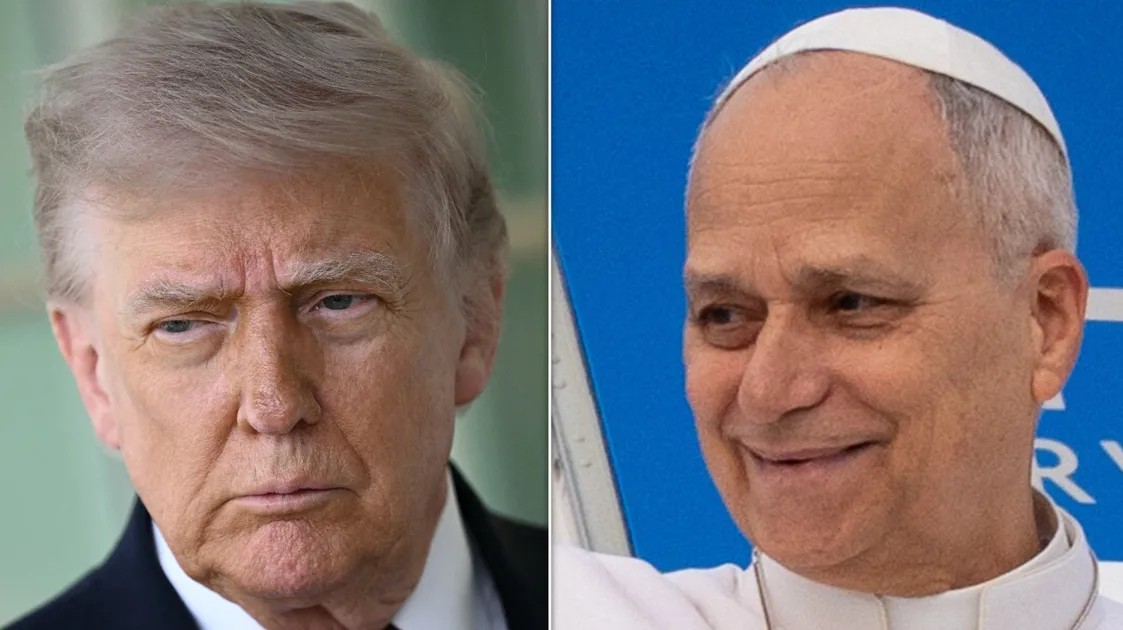
A deepening rift has emerged between President Donald Trump and the Vatican, following a series of unprecedented verbal attacks by the President against Pope Leo XIV. Religious scholars and theologians are characterizing Trump’s recent rhetoric—specifically his claim that the Pope “likes crime”—as a fundamental misunderstanding of the papacy and a bizarre departure from political norms.
Зміст
The Catalyst: A Clash of Global Visions
The tension escalated after a 60 Minutes segment featured American cardinals discussing the Pope’s increasingly direct stance on international conflicts, specifically regarding the U.S.-Israeli war in Iran. In response, President Trump launched a multi-pronged attack on Truth Social and in press briefings, accusing the Pope of being:
- “Weak on crime” and “terrible for foreign policy.”
- A “politician” rather than a religious leader.
- Preferring criminal activity, stating in a Sunday night briefing, “I don’t think he’s doing a very good job, he likes crime, I guess.”
Trump also suggested that the selection of Leo—the first U.S.-born Pope in history—was a strategic move by the Church to “deal with” his administration.
Decoding the “Soft on Crime” Allegation
Experts find the President’s use of law-and-order terminology toward a religious leader to be logically disconnected from the reality of the papacy.
Robert Orsi, a professor of religious studies at Northwestern University, noted that Trump appears to be “repurposing” political slogans from the 1960s and 70s. “‘Soft on crime’ was a major talking point of the Nixon administration,” Orsi observed, noting that applying such a label to a Pope is “undignified” and makes little sense in a theological context.
Theology professor Peter Casarella of Duke Divinity School offered a different perspective on the “crime” accusation. He suggests Trump may be attempting to “turn the tables” on the Pope’s criticisms regarding migrant treatment and border security. By labeling the Pope as someone who “likes crime,” Trump may be attempting to frame the Pope’s humanitarian concerns as a threat to American domestic security.
“The obvious problem is that no Pope has ever said that criminal behavior is fine or that borders should be eliminated,” Casarella noted. “Neither of those positions are in line with the teachings of Christ or of the Church.”
A Theological Defense of Peace
The conflict highlights a fundamental disagreement over the role of the Pope in modern geopolitics. While Trump views the Pope’s calls for peace as political interference, scholars argue these calls are a core requirement of the office.
- The Mandate for Peace: Scholars point out that calling for peace is not a political stance but a religious duty. They cite the “Just War” doctrine, which requires proportional responses and the protection of civilians—principles that clash with threats of total civilizational destruction.
- The “Gaslighting” Argument: Deepak Sarma, a scholar at Case Western Reserve University, described Trump’s comments as “blatant attempts at gaslighting.” He argued that by falsely attributing criminal sympathies to the Pope, Trump is using a pattern of rhetorical mischaracterization.
- Impact on Supporters: This rhetorical strategy may be backfiring. Sarma noted that while such tactics often resonate with the President’s core base, they appear to be alienating Catholic voters, with recent polls showing Trump’s support among Catholics dropping below 50%.
The Pope’s Response
Pope Leo XIV has maintained a composed, non-confrontational stance. Speaking from a flight to Algiers, the Pope clarified that his mission is rooted in the Gospel rather than partisan politics.
“I do not look at my role as being political… I don’t want to get into a debate with him,” the Pope stated. He emphasized that his focus remains on promoting dialogue, multilateralism, and the “message of the Gospel,” which prioritizes peacemaking over political combat.
Conclusion: The standoff represents more than a personal feud; it is a clash between a populist political doctrine centered on national security and a traditional religious mandate focused on global humanitarianism and peace.