




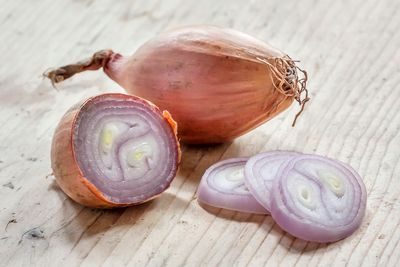
If you’ve ever stood in a grocery aisle and stared at a stack of red onions and wondered what really makes the sauce pop, the answer is almost certainly shallots.
It is the silent professional of the onion world. Not loud. Not aggressive. Simply reliable.
Botanically it is Allium cepa, variety aggregatum. This sounds like something you’d find in a thick textbook, but basically it means it’s a close relative of the common onion. It belongs to the Amaryllidaceae family and has its roots in Asia. Today, it is grown all over the world for one reason: its bulbs.
These are not your ordinary, spicy yellow onions. The bulbs are angular and small, usually less than five centimeters long. They grow in clusters on a single base and resemble their garlic relatives more than the individual giants of the onion family.
Why is this important to you as a chef?
Taste.
Shallots are mild. They lack the sharp, eye-watering bite that makes chopping red onions difficult. Instead, they offer a delicate, aromatic sweetness that accentuates the meat and sauces without dominating them. You want the depth of onion flavor, but not the burn. This is where shallots come into play.
The plant itself is interesting when you look at it closely. Although it is technically a perennial, most gardeners consider it an annual. The leaves are short, hollow and cylindrical. If you catch them while they are still green, you can also eat them and add a subtle onion flavor to salads or garnishes. In summer, the plant sends out flowers that are typically lavender or red, tightly clustered in compact umbel.
Getting them into the ground is uncomplicated. Plant them in early spring. They don’t require prime real estate; Any good garden soil will do. you harvest the bulbs by summer.
It is an easy-care plant that offers a rewarding taste.
Think about the last time you made vinaigrette. Did you use raw onion? Probably not. That would have been too harsh. Chopped shallots mixed in give the necessary backbone without the aggression. They are a bridge between the raw bite of a scallion and the cooked depth of a yellow onion.
You might wonder why you should bother with them when onions are cheaper and easier to find. The difference is in the nuance. The shallot dissolves in the dish and mixes so thoroughly that you taste the end result, not the ingredient. It’s subtle. It’s sophisticated.
And unlike garlic, which can sometimes overwhelm a dish if you’re not careful, shallots support. They hold the structure of the sauce together without demanding attention.
So the next time you need it in a recipe, don’t substitute regular onion unless you’re changing the amount significantly. You lose the special, mild aromatic quality that makes a dish feel complete.
They are small. They are clustered. They’re waiting in the produce department to make your cooking feel a little less chaotic and much more refined.
Remember to plant them early. It is worth waiting for the summer harvest.