



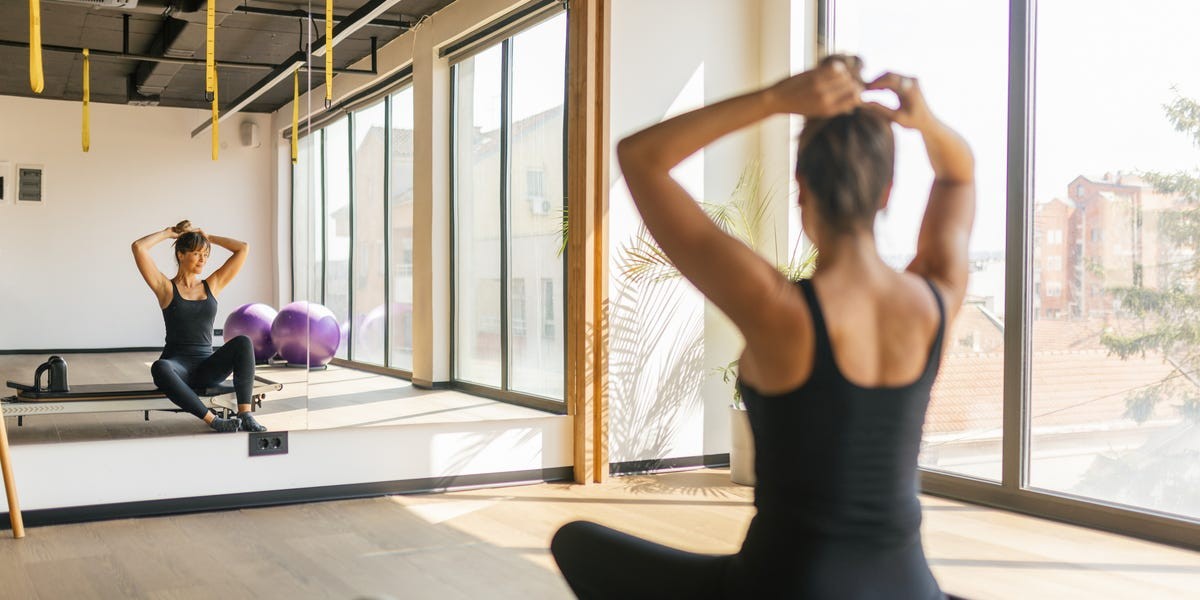
Sticky socks on. Matching set zipped up. You slide that oversized claw clip into place with practiced ease. The aesthetic is undeniable. But before you hop onto that carriage, consider the mechanics. That chic plastic chunk isn’t just hair. It’s an obstacle.
You’re not a model. At least, you shouldn’t be treating the mat like a runway.
“How you wear your hair to workout matters,” Carrie Pagès says.
Pagès runs Pilates in Wilmington. She’s seen twenty years of bodies twist, stretch, and collapse under bad posture choices. The wrong hair choice warps your form. It ruins the quality of your movement. We care about how we look. But what if looking good hurts the workout?
Зміст
The Problem With The Clip
Most people walk in with two main offenders. The slicked-back bun. The claw clip.
Pagès calls them alignment killers. The moment you lay back, that clip prods the base of your skull. Your head tilts up. Your spine curves away from neutral. It feels annoying, sure. But it’s structurally damaging too.
Think about “tech neck.” You sit at a computer. Your head juts forward. The muscles at the back of your neck lengthen until they are essentially useless. They atrophy. In a good Pilates session, we try to reverse that. We gently press the back of the skull into the mat. We wake those dead muscles up. We build strength where it’s needed most.
Now add a two-inch plastic clip to that equation. You can’t press in. You’re protecting your hair more than your body. The clip prevents the contact needed for the exercise. It stops you from doing the work.
Claw clips make overhead movements a nightmare. Pagès explains that your head needs to hang loose. It allows the spine to flex freely. Try getting your bum in the air while your hair is anchored by a hard object. Good luck. There’s also subconscious tension. You stiffen up. You guard your style instead of moving through your limits. Some studios actually ban them now. The clips scratch the upholstery. They rip the fabric. You’re hurting the machine and yourself.
What Actually Works
Ditch the bulk. Aim for high.
High ponytails work. High buns are Pagès’ go-to. They sit top-of-head, clear of the occipital ridge. No bulk pressing on the back. You get full range of motion. Low ponytails are fine too, as long as the elastic is right at the nape. Founding father vibes. Functional. Simple.
Braids? Complicated.
“I’d be careful with a French braid,” Pagès notes.
Why? Because you’ll worry about it. You spend time doing the plait. You don’t want to ruin it. When the curl exercise comes—tucking the chin to chest—that tension might make you hesitate. You subconsciously modify the movement to save the braid. Subtle shifts in movement accumulate into big posture issues over time. Side ponies or pigtails keep hair away from your face and eyes without the structural interference of a central bun or clip.
Loose Hair Is A Liability
Sure, tying your hair up is extra effort. Just leave it down? Right?
Bad idea.
Hair in the face causes “funky head flips.” Try doing the Swan exercise. You’re prone. You arch your back. Your hair falls over your eyes. You jerk your head back to clear your vision. That jerky motion is unnecessary. It compromises the curve. It throws off your center line. You want smooth arcs. Not panic shakes.
Then there is safety. Long hair on a reformer is risky. Springs grab stray strands. If you’re long enough, your hair drags on the floor while your feet are up in the air. Depending on the debris in the apparatus well, that’s a tangle waiting to happen. Or a pulled strand. Or both.
Just Sweat
The studio isn’t a photo shoot. It’s a gym with specific mechanics.
Your hairstyle shouldn’t make a statement. It should stay out of the way. Be thoughtful about the choices. Because the hair isn’t just an accessory. It’s part of the apparatus now. And currently? It’s in the way.